Publish date: Feb 10, 2026
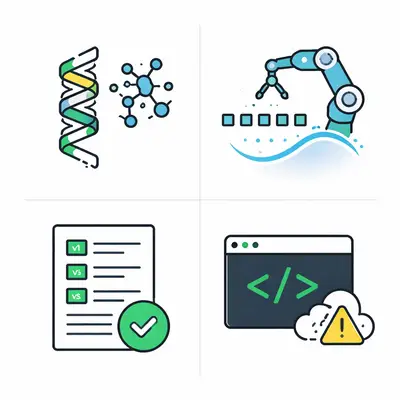
Today’s theme is less “one flashy demo” and more infrastructure you can actually build on: open weights for biomolecular prediction, tokenization that makes robot control scale like language, prompts treated like deployable artifacts, and the growing reality that agentic coding tools have uptime risk.
<h2>1) ByteDance open-sources <em>Protenix-v1</em>: an AlphaFold3-style, all-atom biomolecular predictor</h2>

<p><strong>What happened:</strong> ByteDance released <strong>Protenix-v1</strong>, describing it as “<strong>a trainable PyTorch reproduction of AlphaFold 3</strong>,” and—crucially—published both <strong>code and model parameters</strong> under the <strong>Apache-2.0</strong> license. The repository emphasizes support for <strong>proteins, DNA/RNA, and ligands</strong>, aiming at full biomolecular complexes rather than protein-only folding.</p>

<p><strong>Primary source:</strong> <a href="https://github.com/bytedance/Protenix?utm_source=openai" target="_blank" rel="noopener noreferrer">Protenix GitHub repository</a></p>

<h3>Why it matters</h3>
<ul>
  <li><strong>Open weights + permissive license</strong> lowers the barrier from “interesting research” to “something teams can integrate,” including commercial experimentation without bespoke licensing.</li>
  <li>AlphaFold3-class capabilities have been difficult to reproduce openly—especially for <strong>protein–ligand</strong> and <strong>nucleic-acid</strong> complexes—so a practical, installable reference stack changes the baseline for the ecosystem.</li>
  <li>The repo isn’t just a model dump: it includes documentation for <strong>inputs/outputs</strong> and a pipeline that mentions <strong>PDB/CIF → JSON</strong> conversion for inference workflows.</li>
</ul>

<h3>What to say (without overclaiming)</h3>
<p>Frame this as an “<strong>open AF3-style moment</strong>” focused on what’s concretely shipped: reproducible code, published parameters, and tooling that suggests the authors want it to be used—not just cited.</p>

<h3>What to verify before publishing</h3>
<ul>
  <li><strong>Performance claims:</strong> If you reference comparisons to AlphaFold3, attribute them explicitly to the project’s reported benchmarks and clarify any evaluation constraints (“under matched conditions,” dataset differences, etc.).</li>
  <li><strong>Demo availability:</strong> If you mention any web demo, confirm access requirements and limitations (queues, rate limits, login).</li>
</ul>

<h3>Visuals to include</h3>
<ul>
  <li>Screenshot: README sections showing <strong>license</strong> + <strong>install/inference</strong>.</li>
  <li>A simple diagram: <em>Complex inputs (protein + nucleic acid + ligand) → Protenix → predicted all-atom structure</em>.</li>
  <li>Optional table: “open vs. closed AF3-like systems” (license, weights, multi-molecule support, evaluation tooling).</li>
</ul>
<h2>2) Robotics: OAT (Ordered Action Tokenization) brings “anytime inference” to continuous robot control</h2>
<p><strong>What happened:</strong> A new paper proposes <strong>OAT: Ordered Action Tokenization</strong>, a learned discretization scheme designed to make continuous robot actions compatible with <strong>autoregressive (next-token) policies</strong>. The headline feature: <strong>prefix-based “anytime” control</strong>—generate fewer tokens for speed, more tokens for fidelity.</p>
<p><strong>Primary source:</strong> <a href="https://arxiv.org/abs/2602.04215?utm_source=openai" target="_blank" rel="noopener noreferrer">OAT on arXiv</a></p>
<h3>The problem (plain English)</h3>
<p>LLM-style scaling loves discrete tokens. Robots produce continuous actions. Many tokenization approaches force awkward trade-offs: long sequences, unstable decoding, or token spaces that don’t behave nicely left-to-right. OAT frames the goal as achieving:</p>
<ul>
<li><strong>High compression</strong></li>
<li><strong>Total decodability</strong></li>
<li><strong>Left-to-right causally ordered token space</strong></li>
</ul>
<h3>What’s interesting here</h3>
<p>OAT’s ordered tokens aim to make early tokens represent a coarse action plan and later tokens refine it—so you can stop early when latency matters. The paper also reports results across <strong>20+ tasks</strong> spanning simulation and real-world setups (as stated in the abstract).</p>
<h3>Writer angle</h3>
<p><strong>Tokenization is becoming the new battleground</strong> in robotics. Architectures get the headlines, but the representation layer often decides whether next-token prediction is viable in real control loops.</p>
<h3>Optional context</h3>
<p>If you want a sidebar on the broader trend: <a href="https://arxiv.org/abs/2602.03310?utm_source=openai" target="_blank" rel="noopener noreferrer">RDT2</a> is another recent arXiv entry pointing at discrete action representations (via RVQ tokenization) as a central design axis in VLA models.</p>
<h3>Visuals to include</h3>
<ul>
<li>One figure concept: a continuous action vector turning into an ordered token sequence, with an arrow showing “stop at token k” for anytime control.</li>
<li>Small callout box listing the three desiderata (compression, decodability, causal ordering).</li>
</ul><h2>3) LLM Ops: MLflow Prompt Registry makes prompts feel like real software (versioning + regression tests)</h2>
<p><strong>What happened:</strong> MLflow’s GenAI tooling (MLflow 3+) supports prompt development with stronger engineering discipline: <strong>immutable prompt versions</strong>, diffs, aliases (prod/staging), and evaluation loops—so prompts can be treated like <strong>deployable artifacts</strong> with regression testing.</p>
<p><strong>Primary sources:</strong>
<a href="https://mlflow.org/docs/latest/genai/prompt-registry/?utm_source=openai" target="_blank" rel="noopener noreferrer">MLflow Prompt Registry docs</a>
·
<a href="https://www.mlflow.org/docs/latest/genai/version-tracking/quickstart/?utm_source=openai" target="_blank" rel="noopener noreferrer">Version tracking quickstart</a>
</p>
<h3>Why it matters</h3>
<p>Prompt changes are deceptively risky: tiny edits can silently break compliance, structure, or factuality. MLflow’s approach nudges teams toward a workflow where you can answer: <em>Which prompt version produced this output, with what model settings, and did it pass evaluation?</em></p>
<h3>Concrete benefits to highlight</h3>
<ul>
<li><strong>Versioning + diffs</strong> (Git-like iteration, but prompt-native)</li>
<li><strong>Immutable versions</strong> for reproducibility</li>
<li><strong>Aliases</strong> for promotion/rollback (e.g., staging → prod)</li>
<li><strong>Lineage</strong> connecting prompt versions to runs/evals</li>
</ul>
<h3>A practical workflow you can implement this week</h3>
<ol>
<li>Create a <strong>golden set</strong> (20–200 examples) representing your core use-cases and failure modes.</li>
<li>Define pass/fail checks (accuracy, formatting, safety, policy constraints, tone).</li>
<li>Every prompt change creates a <strong>new immutable version</strong>.</li>
<li>Run evals automatically; only then promote the <strong>prod alias</strong>.</li>
</ol>
<h3>Visuals to include</h3>
<ul>
<li>Screenshot: “Key Benefits” from the Prompt Registry docs.</li>
<li>A simple pipeline diagram: PR → new prompt version → eval → promote alias.</li>
</ul><h2>4) Claude Code and agentic coding distribution: powerful… and now operationally visible</h2>
<p><strong>What happened:</strong> Agentic coding continues its shift from novelty to default workflow. <strong>Claude Code</strong> is positioned as a terminal-first coding agent with IDE integration that can navigate codebases, propose multi-file changes, and request permission before running commands. At the same time, dependency risk is becoming tangible: a recent outage disrupted developers relying on Claude/Claude Code.</p>
<p><strong>Primary sources:</strong>
<a href="https://claude.com/product/claude-code?utm_source=openai" target="_blank" rel="noopener noreferrer">Claude Code product page</a>
·
<a href="https://www.theverge.com/news/873093/claude-code-down-outage-anthropic?utm_source=openai" target="_blank" rel="noopener noreferrer">Outage coverage (The Verge)</a>
</p>
<h3>The real inflection point</h3>
<p>Autocomplete changed how we type. Agents change how work gets sequenced: <em>issue → plan → multi-file edits → tests → PR</em>. When that becomes your default, <strong>reliability becomes a product feature</strong>, not an afterthought.</p>
<h3>Two grounded takeaways</h3>
<ul>
<li><strong>Distribution is the story:</strong> terminal + IDE integration makes agents easy to adopt inside existing engineering habits.</li>
<li><strong>Resilience is the next bottleneck:</strong> teams need fallback plans (alternative providers, local tools, degraded modes) because outages now halt real work.</li>
</ul>
<h3>Visuals to include</h3>
<ul>
<li>A clean screenshot-style graphic: terminal agent proposing changes → user approval gate → command execution.</li>
<li>A small “risk box”: uptime dependency, vendor lock-in, auditability, and evaluation.</li>
</ul><h2>What to watch next</h2>
<ul>
<li><strong>Open biomolecular modeling:</strong> Whether Protenix becomes a community reference stack (fine-tunes, benchmarks, third-party tooling).</li>
<li><strong>Robotics token wars:</strong> Whether ordered/anytime action tokens outperform diffusion-style control as tasks get longer and latency budgets tighten.</li>
<li><strong>Prompt engineering grows up:</strong> More teams will standardize “prompt CI”—versioning + evals—like they did for models and datasets.</li>
<li><strong>Agent reliability:</strong> Expect more attention on SLAs, local fallbacks, and agent observability as coding agents become mission-critical.</li>
</ul>
<p><strong>Sources (primary):</strong> <a href="https://github.com/bytedance/Protenix?utm_source=openai" target="_blank" rel="noopener noreferrer">Protenix GitHub</a>; <a href="https://arxiv.org/abs/2602.04215?utm_source=openai" target="_blank" rel="noopener noreferrer">OAT arXiv</a>; <a href="https://mlflow.org/docs/latest/genai/prompt-registry/?utm_source=openai" target="_blank" rel="noopener noreferrer">MLflow Prompt Registry</a>; <a href="https://www.mlflow.org/docs/latest/genai/version-tracking/quickstart/?utm_source=openai" target="_blank" rel="noopener noreferrer">MLflow version tracking</a>; <a href="https://claude.com/product/claude-code?utm_source=openai" target="_blank" rel="noopener noreferrer">Claude Code</a>.</p>
<p><strong>Additional context:</strong> <a href="https://www.theverge.com/news/873093/claude-code-down-outage-anthropic?utm_source=openai" target="_blank" rel="noopener noreferrer">The Verge outage report</a>; <a href="https://arxiv.org/abs/2602.03310?utm_source=openai" target="_blank" rel="noopener noreferrer">RDT2 arXiv</a>.</p>