Want to learn how to USE AI technology to make money and/or your life easier? Join our FREE AI community here: https://www.skool.com/ai-with-apex/about
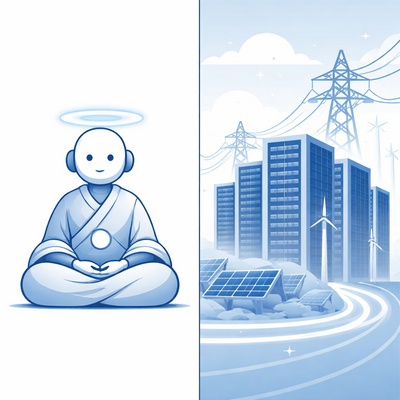
From Robot Monks to Flexible Data Centers: AI’s Human Side Meets Its Power Problem
AI is starting to look less like a software trend and more like infrastructure. On one side, South Korea is weaving AI into everyday social settings; on the other, power systems are adjusting to the energy demands of the data centers behind the boom.
TL;DR
- South Korea appears unusually open to AI in daily life, including eldercare, companionship, and even religious settings.
- A major reason is demographic pressure: the country faces a large and growing care-worker shortage.
- South Korea is also backing AI and robotics with industrial policy, especially in humanoids and physical AI.
- At the same time, AI data centers are becoming major power customers, with U.S. electricity use from data centers projected to rise sharply by 2028.
- Utilities and operators are increasingly exploring “flexible load” strategies, where data centers reduce or shift power use during grid stress instead of acting like fixed demand.
South Korea is making AI a mainstream social presence
What happened
South Korea is emerging as one of the clearest examples of AI moving into socially sensitive parts of daily life, not just office software or consumer chatbots. Recent reporting points to a mix of eldercare robots, companionship devices, and even Buddhist robot monks being used as outreach and support tools.
Why it matters
This suggests AI adoption is being shaped by more than novelty. In South Korea, demographics, labor shortages, and national industrial strategy are making AI feel less like a speculative technology and more like a practical social tool.
Key details
- South Korea’s care-worker shortfall was estimated at 190,000 in 2022 and could reach 1.55 million by 2042, according to a 2024 Bank of Korea estimate cited by Korea JoongAng Daily.
- Korean companies including major electronics groups are actively developing robots and AI devices aimed at the “silver generation,” with products framed around caregiving, support, and companionship.
- South Korean temples have experimented with AI-powered robot monks such as Gabi, designed to answer questions, bow, and help explain Buddhism to visitors.
- Reporting from the AP argues South Korea may have a strategic opening in physical AI and robotics, where its manufacturing base could be an advantage over markets centered on English-language chatbots.
- A 50.4 billion won public-private humanoid robotics program has been launched for hospital and residential care use cases.
Source links
https://koreajoongangdaily.joins.com/news/2025-05-21/business/industry/Assistance-for-the-aging-Samsung-LG-to-release-caregiving-robots-for-silver-generation/2299709?utm_source=openai
https://www.smithsonianmag.com/smart-news/meet-gabi-the-new-robot-monk-at-a-buddhist-temple-in-south-korea-its-the-latest-robot-to-take-up-religious-practice-180988695/?utm_source=openai
https://apnews.com/article/c3e00f5264e109b8b767559e9e09c3dc?utm_source=openai
AI data centers are becoming a grid problem as much as a compute story
What happened
The rapid expansion of AI infrastructure is colliding with power constraints. As data centers consume more electricity, grid planners and operators are looking for ways to connect large new facilities faster without treating them as completely inflexible loads.
Why it matters
The next bottleneck for AI may not just be chips or servers. In many regions, access to reliable electricity is becoming a competitive constraint, which means data centers that can shift or trim demand may gain an edge.
Key details
- Data centers accounted for about 4.4% of U.S. electricity use in 2023 and could rise to 6.7% to 12% by 2028, according to a recent summary of U.S. government-backed analysis.
- EPRI launched a 2026 framework for measuring and planning around data-center flexibility, including the magnitude, timing, duration, and frequency of load response.
- EPRI has described flexibility as the “third leg” of the speed-to-power equation, alongside generation and transmission.
- The idea is to make data centers behave more like controllable industrial loads by shifting non-urgent computing, using batteries or backup systems, or temporarily reducing consumption during grid stress.
- The U.S. Department of Energy launched a data center grid integration test bed in May 2026 to explore how facilities can support grid reliability during strained periods.
Source links
https://www.tomsguide.com/ai/i-kept-hearing-that-ai-data-centers-are-draining-towns-dry-so-i-looked-at-the-evidence?utm_source=openai
https://www.publicpower.org/periodical/article/epri-launches-framework-reduce-time-power-data-centers?utm_source=openai
https://www.datacenterdynamics.com/en/news/us-doe-launches-data-center-grid-intergration-test-bed-at-national-laboratory-of-the-rockies/?utm_source=openai
Why these two stories fit together
What happened
These developments are unfolding in very different places, but they describe the same transition. AI is moving outward into institutions such as temples, care systems, and homes while also pushing deeper into the physical systems that support it, especially the electric grid.
Why it matters
This is what maturity looks like for a general-purpose technology. The interesting questions are no longer only about model performance, but about where AI fits socially, who needs it most, and what infrastructure must change to keep it running.
Key details
- South Korea’s adoption story is tied to aging, labor scarcity, and a national push into robotics and embodied AI.
- The data-center story shows that AI’s growth is now constrained by physical systems, especially power availability and grid planning.
- Flexible load strategies may help, but they do not remove the need for more generation, transmission, and local grid upgrades.
- Taken together, the two stories show AI becoming both more intimate and more industrial at the same time.
Source links
https://koreajoongangdaily.joins.com/news/2025-05-21/business/industry/Assistance-for-the-aging-Samsung-LG-to-release-caregiving-robots-for-silver-generation/2299709?utm_source=openai
https://www.publicpower.org/periodical/article/epri-launches-framework-reduce-time-power-data-centers?utm_source=openai
AI is no longer just something people use on a screen. It is becoming part of care systems, religious outreach, industrial strategy, and the power grid itself—and that makes the next phase of the AI era feel much more real.
---
Want to learn how to USE AI technology to make money and/or your life easier? Join our FREE AI community here: https://www.skool.com/ai-with-apex/about