Want to learn how to USE AI technology to make money and/or your life easier? Join our FREE AI community here: https://www.skool.com/ai-with-apex/about
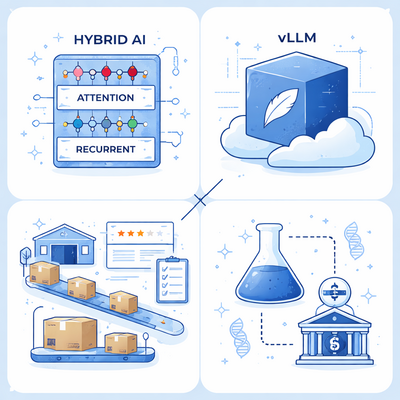
Today in AI and Science: Hybrid Models, Disposable Inference, Retail’s Hidden AI Shift, and MIT’s Research Warning
Today’s strongest stories point to an AI industry that is getting more specific and more practical. The big changes are happening in model design, short-lived infrastructure, and back-end business systems, while the research world is reminding everyone that long-term science investment still underpins the next wave.
TL;DR
- Ai2 says hybrid language models can outperform standard transformers on meaning-bearing tokens and state-tracking tasks, even if transformers still lead on exact copying.
- Hugging Face now lets developers launch a private, OpenAI-compatible vLLM server on HF Jobs with a single command for temporary workloads.
- MIT is amplifying a Scientific American argument that curiosity-driven science remains essential to U.S. innovation, security, and economic strength.
- Retail’s most important AI gains may be happening behind the scenes in ranking, forecasting, logistics, and internal engineering rather than flashy shopper-facing tools.
- The common thread is maturity: AI progress is increasingly about better architectures, lighter deployment, and durable research foundations.
AI2 says hybrid models may beat transformers where meaning matters
What happened
Ai2 published a new analysis comparing its 7B Olmo 3 transformer with Olmo Hybrid, a closely matched model that mixes attention and recurrent layers. The core claim is not that the hybrid wins everywhere, but that it performs better on particular kinds of tokens that carry meaning or require tracking state across a sequence.
Why it matters
This is a more useful way to think about model quality than relying on a single average-loss number. If different architectures are better at different cognitive-style tasks, the next phase of model development may be shaped less by leaderboard averages and more by what kinds of reasoning or recall matter in practice.
Key details
- Ai2 says Olmo 3 and Olmo Hybrid were aligned on data, tokenizer, and training recipe so architectural differences would be easier to isolate.
- The hybrid model performed especially well on meaning-bearing tokens such as nouns, verbs, and adjectives.
- Ai2 also found hybrid gains on tokens that require state tracking, including pronoun reference resolution.
- The advantage narrowed or disappeared on copy-style prediction, where the next token is an exact repetition from earlier context.
- Ai2 reports that closing braces and brackets in text, code, and markup also remained an area where attention-heavy models retained strength.
- The broader takeaway from the post is that token-filtered evaluation can reveal architectural tradeoffs that average loss hides.
Source links
https://huggingface.co/blog/allenai/hybrid-token-prediction
Hugging Face makes temporary model serving feel lighter
What happened
Hugging Face published a new workflow for launching a private vLLM server on HF Jobs with a single command. The setup uses the official vllm/vllm-openai image and exposes an OpenAI-compatible API for short-lived inference tasks.
Why it matters
This is a clear sign that model infrastructure is becoming more disposable and composable. Instead of standing up permanent serving systems for every use case, teams can increasingly spin up temporary endpoints for tests, evaluations, demos, and batch jobs, then shut them down.
Key details
- Hugging Face says users can launch the server with
hf jobs run. - The endpoint is OpenAI API-compatible, which reduces switching costs for teams already using OpenAI-style clients.
- HF positions this workflow for temporary workloads such as tests, evals, demos, and batch generation rather than long-lived production serving.
- The endpoint is private and gated, requiring a Hugging Face token with read access to the job namespace.
- Hugging Face contrasts HF Jobs with its Inference Endpoints product, which it describes as the better fit for stable production infrastructure.
- The post includes a usage-based billing example of an a10g-large at $1.50 per hour.
Source links
https://huggingface.co/blog/vllm-jobs
MIT makes the case for long-term science investment
What happened
MIT highlighted a Scientific American special section arguing that curiosity-driven science remains a core ingredient in American success. The package connects basic research to eventual breakthroughs in fields including health, energy, AI, and public safety, while also warning about funding instability and pressure on the research pipeline.
Why it matters
It is an important counterweight to the fast-moving AI product cycle. Commercial systems may dominate headlines, but the institutions behind future breakthroughs still depend on patient public investment, stable funding, and a research environment that can support long-horizon work.
Key details
- MIT’s June 25 write-up points to Scientific American’s special section “The Young American Scientists,” released on June 16.
- MIT President Sally Kornbluth argued for renewed public investment in science and framed discovery as part of the country’s long-term strength.
- The package highlights work from Alice Stanton on brain tissue models relevant to Alzheimer’s and Parkinson’s research.
- It also points to Bob Mumgaard and fusion commercialization at Commonwealth Fusion Systems.
- Another example is Alex Zhang’s work on “context rot” in language models using recursive language models.
- The broader discussion raises concerns about NIH and NSF funding instability, immigration uncertainty for international scientists, and declining trust in expertise.
Source links
https://news.mit.edu/2026/mit-media-exploring-how-curiosity-driven-science-essential-ingredient-americas-success?utm_source=openai
https://news.mit.edu/news-clip/scientific-american-331?utm_source=openai
https://news.mit.edu/2026/mit-media-exploring-how-curiosity-driven-science-essential-ingredient-americas-success
Retail AI’s biggest impact may be happening out of sight
What happened
A lead summary from MIT Technology Review points to a familiar but increasingly important enterprise pattern: retail AI is having meaningful effects behind the scenes more than at the customer interface. The emphasis is on operational systems rather than flashy front-end experiences.
Why it matters
This is often where AI creates the most durable business value. Better ranking, inventory flow, forecasting, and internal tooling may look less dramatic than consumer demos, but they can shape margins, availability, and execution across entire retail organizations.
Key details
- The available summary points to search ranking and product discovery as a major area of impact.
- It also highlights inventory movement and supply-chain operations.
- Engineering productivity and internal decision-making are part of the same shift.
- The larger takeaway is that retail AI appears to be following the same pattern seen in other industries, where operational gains arrive before highly visible customer experiences.
AI is settling into a more serious phase: better architectural diagnosis, lighter-weight inference workflows, quieter enterprise adoption, and a renewed argument for the research system underneath it all. The glamour layer still matters, but today’s strongest signals came from what happens deeper in the stack.
---
Want to learn how to USE AI technology to make money and/or your life easier? Join our FREE AI community here: https://www.skool.com/ai-with-apex/about