Want to learn how to USE AI technology to make money and/or your life easier? Join our FREE AI community here: https://www.skool.com/ai-with-apex/about
Today’s AI Story: From Black Boxes to Real-World Workflows
Today’s tech story is less about flashy demos and more about systems becoming usable in the real world. The biggest moves are happening in model debugging, clinical support, and new health-data infrastructure built around home monitoring.
- Goodfire is pushing interpretability from research concept toward an engineering workflow, with a tool reportedly designed to inspect and adjust model behavior during training.
- Google DeepMind’s AI co-clinician research focuses on evidence-grounded support for doctors and patients, not autonomous replacement of clinicians.
- Beacon Biosignals is building a home-sleep EEG platform that it says is already being used across more than 40 clinical trials.
- A faith-branded mobile network story highlights how telecom filtering tools are being repackaged as identity and values products.
- An MIT profile on linguistics and cognition is a useful reminder that language technology still sits inside human social context.
Goodfire wants to make LLM training something engineers can actually debug
What happened
Goodfire is pitching interpretability as a practical layer in the AI stack rather than a purely academic safety field. Reporting around its new Silico tool describes a system aimed at inspecting and adjusting a model’s internal behavior during training, while Goodfire’s own materials emphasize large-scale interpretability infrastructure and sparse autoencoders.
Why it matters
If model developers can understand and intervene earlier in training, AI development starts to look more like software engineering and less like black-box trial and error. That could matter for reliability, customization, and safety, especially as companies look for ways to operationalize interpretability instead of treating it as a post-hoc audit step.
Key details
- Secondary coverage says Goodfire’s Silico is framed as a tool for inspecting and adjusting model behavior during training, not only after deployment.
- Goodfire’s February 2026 technical post says the company is building infrastructure to harvest activations from very large models and highlights sparse autoencoders as a core method for decomposing internal activations into interpretable features.
- Goodfire’s website describes interpretability as a path toward more intentional model design.
- Goodfire also claims one example where interpretability-guided training reduced hallucinations by 58%, which should be read as a company-reported result rather than an industry-wide benchmark.
- In a public interview, Goodfire leaders discuss intentional model design and the limits of current interpretability methods, underscoring that this remains an emerging engineering area.
Source links
https://databubble.co/news/this-startups-new-mechanistic-interpretability-tool-lets-you-debug-llms?utm_source=openai
https://www.goodfire.ai/blog/interpretability-infra-at-frontier-scale?utm_source=openai
https://www.goodfire.ai/?utm_source=openai
Google DeepMind is building an AI co-clinician, not an AI doctor
What happened
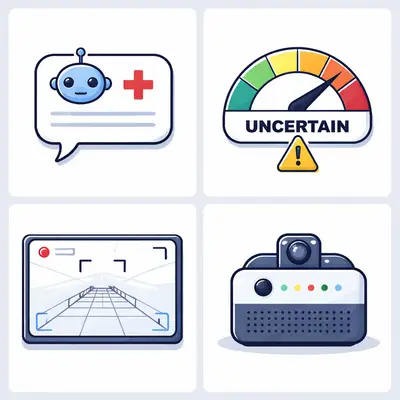
Google DeepMind has introduced an AI co-clinician research program designed to support physicians and patients with evidence synthesis, medication questions, and multimodal telemedical interactions. The company presents it as an assistive system and explicitly says these tools are best used under clinical supervision.
Why it matters
This is a meaningful shift from medical benchmark chasing toward workflow-level augmentation. The important distinction is that DeepMind is defining a role for AI inside care delivery where citation, verification, and supervision matter more than a headline claim of autonomy.
Key details
- DeepMind positions the work as a step beyond earlier systems such as MedPaLM and AMIE, moving from exam-style performance and text consultations toward collaborative support.
- In one evaluation described by the company, physicians preferred the system’s evidence synthesis responses over leading tools.
- DeepMind reports zero critical errors in 97 of 98 realistic primary-care evidence queries in the evaluation discussed on its blog.
- In multimodal telemedicine simulations using live audio and video reasoning, the system could guide patients through tasks such as inhaler correction and shoulder maneuvers.
- DeepMind also says expert physicians still outperformed the system overall, especially on red flags and critical examinations.
- The patient-facing setup uses a dual-agent architecture with a Planner monitoring the interaction and a Talker handling the conversation.
Source links
https://deepmind.google/blog/ai-co-clinician/
https://openai.com/index/making-chatgpt-better-for-clinicians/?utm_source=openai
Beacon Biosignals is turning sleep into a brain-data platform
What happened
Beacon Biosignals, founded by MIT alumni and researchers, is building an AI-driven platform around clinical-grade EEG collected during sleep at home. MIT News reports that the company’s headband-based system is FDA 510(k)-cleared and has already been used in more than 40 clinical trials.
Why it matters
This is a strong example of AI value coming from data infrastructure rather than a chatbot interface. Home-based EEG, longitudinal monitoring, and machine learning together could create a defensible platform for biomarkers, treatment monitoring, and trial design in neurology and psychiatry.
Key details
- Beacon’s core thesis is that sleep offers a scalable and information-rich window into brain function.
- MIT News says the company’s platform is being used across conditions including depression, schizophrenia, narcolepsy, hypersomnia, Alzheimer’s disease, and Parkinson’s disease.
- The company says its technology can support treatment monitoring, disease progression analysis, and patient cohort identification for drug trials.
- MIT News reports that Beacon is using the resulting data to build what it calls a foundation model of the brain.
- The same report says Beacon acquired an at-home sleep apnea testing company serving more than 100,000 patients per year in the U.S.
- MIT News also says the company raised $97 million in November 2025.
Source links
https://news.mit.edu/2026/beacon-biosignals-maps-brain-during-sleep-0501
Faith-branded mobile service shows how network filtering is becoming a product category
What happened
A new mobile network reportedly marketed to Christians has drawn attention for using content filtering as part of its value proposition on top of T-Mobile-based wireless infrastructure. Even without leaning on every launch-specific detail, the broader story is clear: telecom controls are being packaged as cultural and ideological products.
Why it matters
This shifts filtering from a parental-control feature into a statement about identity and governance. It also raises familiar questions about overblocking, who defines harmful content, and how much control carriers or service partners should have over what users can access.
Key details
- T-Mobile documents a feature called Web Guard that blocks adult web content on its cellular network.
- T-Mobile also notes limitations to that filtering system, including categories it may not fully block.
- T-Mobile-based MVNOs are already a large and established part of the U.S. mobile market, making network-level repackaging feasible for niche brands.
- The larger trend is that infrastructure products are increasingly being sold with a values-based identity attached.
Source links
https://www.t-mobile.com/support/plans-features/web-guard-device-content-filter?msockid=114368103cca683c02cc7eae3da46960&utm_source=openai
https://www.androidcentral.com/best-mvnos-use-t-mobiles-network?utm_source=openai
Language and cognition remain a useful counterpoint to the AI cycle
What happened
An MIT News profile of senior Olivia Honeycutt highlights work spanning computation and cognition, linguistics, education, technology, and social context. It is not hard news in the same way as the other items, but it lands as a useful reminder about the limits of purely technical views of language.
Why it matters
AI systems can model and generate language at enormous scale, but human communication is still shaped by culture, identity, learning, and context. That makes interdisciplinary language research especially relevant at a moment when AI products are becoming more capable but not necessarily more socially aware.
Key details
- Honeycutt is a double major in computation and cognition and linguistics.
- The MIT profile places her work at the intersection of brain science, language learning, technology, and group interaction.
- The article contrasts formal analytical traditions in linguistics with sociolinguistic approaches that foreground cultural context.
- That contrast maps neatly onto a central tension in AI: language can be processed statistically without being fully understood socially.
Source links
https://news.mit.edu/2026/improving-understanding-language-olivia-honeycutt-0501
The thread connecting these stories is straightforward: AI is becoming less abstract and more operational. Whether the problem is debugging a model, assisting a clinician, building a brain-data platform, or controlling access at the network layer, the real shift is from capability to infrastructure.
—
Want to learn how to USE AI technology to make money and/or your life easier? Join our FREE AI community here: https://www.skool.com/ai-with-apex/about